
Wayne County Projected Versus Actual Release
A projected date is a calculation based on the current judgment, credits, eligibility rules, and custody facts. It may move. An actual release date records a completed departure from the named custodian. Release eligibility is different again: it marks when parole consideration may begin under the applicable law, not a promise that parole will be granted or that physical release will occur that day.
Sentence expiration can also differ from release eligibility and the day a person leaves a prison. Mandatory supervision may follow or cover a final part of some sentences. A detainer can cause a transfer to another agency when the first custody term ends. For that reason, a Wayne County inmate release date should always carry its exact label and source.
A pretrial Wayne County Jail detainee has no sentence-based projected date. The controlling event may be bond, dismissal, a later judgment, or a transfer. Do not apply prison credit formulas to someone who has not been sentenced.
Find Wayne County Inmate Release Dates
Start by identifying where the person is held and why. Wayne County Jail handles local detention, including many pretrial and short county-sentence cases. South Central Correctional Center and Turney Center Industrial Complex Annex are state facilities whose sentenced offenders belong in TDOC records. A person can disappear from the county roster because of transfer into TDOC, which is not a community release.
- Check the Wayne County current-confinement portal only to decide whether the person remains at the county jail. A missing name does not prove release.
- For a county case, ask the Wayne trial-court clerk for the judgment, bond order, sentencing order, jail-credit entry, and any amended or revocation order.
- Ask the jail for its existing sentence calculation or actual release and transfer fields. The public portal has no projected-date calculator.
- For a state prisoner, search TDOC FOIL, select the correct identity, and copy every date label exactly.
- Read status and location with the dates. An institutional location means state custody continues.
- When a record conflicts or is old, contact the custodian or use the archived-record request rather than estimating a date.
The broader Wayne County released inmates search explains how sheriff, court, state, federal, and immigration records divide after a person leaves the jail.
Note: Save a checked-on date because sentence calculations, hearing status, credits, and custody locations can change.
Wayne County FOIL Release Labels
TDOC describes FOIL as covering felony offenders currently or formerly in its custody or under supervision. The official landing page says a record may include a photograph, status, location, offense, sentence information, parole-hearing status, and release information. It does not promise one universal field named “projected release date.” The live offender detail is the authority for the precise wording.
If the record displays Release Eligibility Date, Sentence Expiration Date, or another label, keep that label. Do not rename it to fit a search phrase. Read “inactive” as the TDOC status shown, not as proof that all custody and supervision ended. “Parole” or “probation” can describe community supervision when the rest of the record supports it.
| FOIL item | What to record |
|---|---|
| Status | The exact term, such as incarcerated, parole, probation, or inactive |
| Location | The institution, supervision setting, or location label shown |
| Sentence information | Offense and sentence facts attached to the matched person |
| Eligibility label | The exact displayed label and date, without paraphrasing |
| Expiration label | The sentence-end label and date when displayed |
| Release information | Any actual or other release wording shown in the detail |
The official FOIL explanation confirms that current and former offenders can be searched.
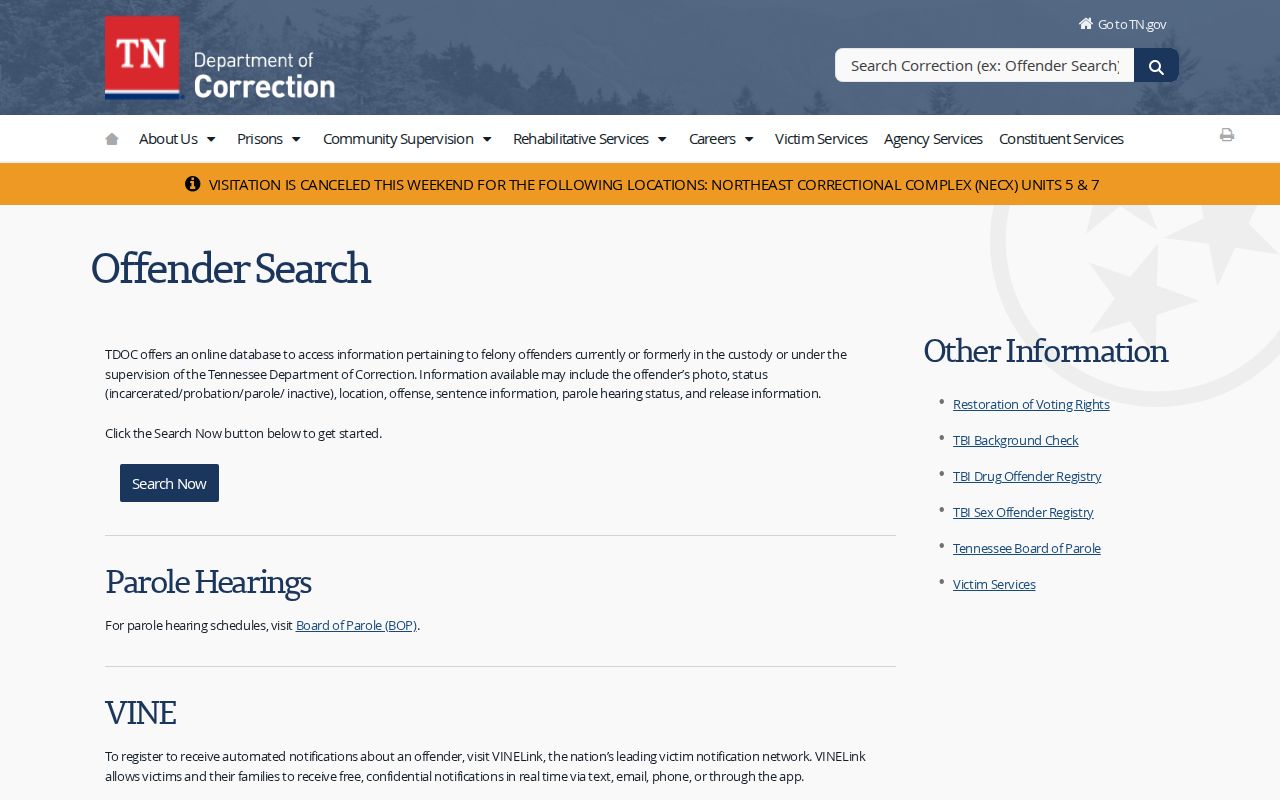
This source establishes the available categories, while the selected live detail supplies the actual label and date for one person.
Wayne County Sentence Date Foundation
A reliable projection begins with the judgment. Determine the offense date, conviction offense, felony classification and range, sentence length, whether terms run at the same time or one after another, pretrial jail credit, place of service, and the governing release provision. These facts control which Tennessee rules apply. A generic percentage calculator cannot resolve them.
Concurrent sentences run together. Consecutive sentences run one after another. Jail credit accounts for qualifying time already held, subject to the controlling order and agency calculation. A release eligibility date identifies the point at which consideration may begin where parole is available. Sentence expiration is the end of the sentence calculation, while actual release records what occurred at a facility.
- Release eligibility
- The statutory point when parole consideration may start in an eligible case.
- Sentence expiration
- The calculated end of the imposed sentence.
- Jail credit
- Qualifying custody time credited under the judgment or agency calculation.
- Detainer
- A request or legal hold that may cause transfer to another custodian.
Wayne County Release Eligibility Percentages
Tenn. Code Ann. § 40-35-501 contains baseline and offense-specific eligibility rules. Baseline figures include 20 or 30 percent for an especially mitigated offender under the stated conditions, 30 percent for Range I, 35 percent for Range II, 45 percent for Range III, and 60 percent for a career offender. Those figures describe eligibility for consideration where applicable. They do not set automatic release dates.
Tennessee does not impose one blanket 85 percent rule on every prisoner. Enumerated serious offenses and offense-date windows may require 85 percent or 100 percent treatment. Certain listed offenses committed from July 1, 2021 through June 30, 2024 use an 85 percent calculation with credits unable to lower the percentage below 70 percent. Provisions for qualifying offenses on or after July 1, 2024 must be read with care because credits, parole eligibility, and sentence expiration can operate differently.
The conviction offense and offense date control. A statutory subsection can replace the baseline range rule. Anyone checking a South Central prisoner should pair the actual judgment with FOIL and current law, then ask TDOC about any mismatch. No public percentage alone proves a Wayne County inmate release date.
Wayne County Sentence Credit Rules
Tenn. Code Ann. § 41-21-236 authorizes discretionary prisoner sentence credits. The framework is often described as up to eight days per month for satisfactory behavior and up to eight for satisfactory program performance. These are not a guaranteed monthly subtraction. Eligibility, TDOC classification, actual earning, removal, and the sentence law all matter.
Newer provisions may let credits affect parole eligibility without reducing sentence expiration. Older or shorter-sentence rules may work differently. The statute also extends relevant TDOC administration to felony offenders housed in local jails, which is important when a TDOC sentence is served in a county setting.
A county sentence of less than one year can involve Tenn. Code Ann. § 41-2-111, which provides a one-quarter deduction for upright behavior under its terms, including qualifying confinement, subject to due process and loss. Other statutes authorize two-for-one credit for eligible people actually assigned to specified road, public, or sheriff work programs. Those laws do not prove Wayne assigned a person or awarded a credit. Ask for the actual jail calculation.
Note: Earned credit is a recorded agency action, not a number a searcher should assume from good conduct.
Why Wayne County Release Dates Change
Future dates change when a legal or administrative input changes. A corrected judgment or added jail credit may move the calculation. Credits can be earned or removed. A parole hearing can end in grant, denial, or deferral, and even a grant can await an approved release plan. A new hold can turn the expected community release into a transfer.
| Factor | Possible effect | Best record |
|---|---|---|
| Corrected judgment | Changes sentence structure or controlling terms | Court’s amended judgment |
| Added jail credit | Adjusts qualifying time already served | Filed order and agency calculation |
| Credit earned or removed | Moves an eligible calculation within the governing law | TDOC or jail sentence record |
| Parole grant, denial, or deferral | Changes the supervision path or consideration timeline | Board action plus FOIL |
| Detainer or new case | Causes added custody or transfer instead of community release | Hold, court, and movement records |
| Administrative recalculation | Updates a displayed future date | Current custodian calculation |
A Board hearing date is not a release date. Hearing officers make recommendations and Board members issue the decision under rules that vary by case. FOIL may show hearing status, but the release record and later supervision status confirm what happened.
Wayne County Custody Date Paths
The correct source changes with custody. A county-jail defendant begins with bond status, the Wayne court, and the jail. A state prisoner begins with FOIL, the judgment, and TDOC sentence management. A federal prisoner belongs in the BOP locator, which labels a future Release Date as projected and a past date as completed BOP release. ICE maintains a separate locator for its custody.
These systems cannot be merged. A Wayne County Jail transfer to South Central is a county departure but not freedom from custody. A state parole status may mean release from prison into supervision. A BOP “Released” location only means BOP custody ended; another correctional system or supervision can still apply.
For an old TDOC record, use the TDOC archived-record request. Include the full name, TOMIS number, date of birth, requester contact details, reason, and a precise description of the existing sentence, movement, release, or discharge record. TDOC says archive-search charges may apply and directs requesters not to prepay.
Confirm Wayne County Actual Release
When the expected day arrives, check the responsible custodian rather than relying on an old projection. For Wayne County Jail, ask the booking desk whether the record shows an actual release or transfer and request the existing release fields if needed. Pair that event with the court order to understand the legal basis.
For TDOC, refresh FOIL and read status, location, and release information together. A future label is still a calculation. An actual release-status and date combination is stronger proof of a completed TDOC event. A parole label indicates supervision, not the end of the sentence.
A pending-event notice may be available through the Wayne County VINELink release check. VINE can alert on a reported event, but the jail or TDOC remains the source for release type and destination. Keep the notice time and wording, then confirm through the agency record.